Overview
Picture this: You’re repainting a 13-metre truck in your spray booth. Your painter is balanced on a ladder, spray gun in hand, trying to reach the top corner of the cab while maintaining consistent spray distance. Every few minutes, work stops while the ladder gets repositioned. The operator stretches awkwardly to avoid climbing down again. The finish quality suffers, it’s dangerous, and the job takes twice as long as it should.
If this scenario sounds familiar, you’re not alone. Across New Zealand’s heavy vehicle refinishing industry, operators are wrestling with the fundamental challenge of how to safely and efficiently access every surface of large vehicles during spray operations.
The Access Problem in Heavy Vehicle Painting
When you’re coating trucks, buses, agricultural machinery, or industrial equipment, traditional access methods create serious operational bottlenecks. Ladders require constant repositioning. Scaffolding consumes valuable floor space in already-tight spray booths. Both options slow productivity and compromise finish quality through inconsistent spray angles and distances.
More critically, they introduce significant safety risks. WorkSafe New Zealand data reveals that construction sector falls from height resulted in 645 reported injuries and 12 fatalities between 2022 and 2023. While spray booth operations aren’t construction per se, the underlying hazard is identical—and the consequences just as severe.
Research shows that over half of workplace falls occur from heights under three metres, with approximately 70 percent involving ladders and roofs. The annual cost of these falls is estimated at $24 million, to say nothing of the human toll. For heavy vehicle refinishing operations, every ladder repositioned is another opportunity for something to go wrong.
Why Heavy Vehicle Spray Operations Need Better Solutions
Large vehicle painting presents unique challenges that amplify the limitations of conventional access equipment:
Scale and complexity. A standard truck cab might reach 3.5 metres high, with side panels extending 13 metres or more. Buses present even larger surfaces. Agricultural machinery and construction equipment add irregular shapes and overhead components. Painters need to reach every surface, often working on multiple sections simultaneously.
Tight working environment. Most spray booths are sized to accommodate the vehicle with minimal clearance. Floor-based scaffolding eats into this limited space, complicating vehicle positioning and restricting movement. In busy commercial operations, setup and breakdown time for scaffolding represents pure lost productivity.
Finish quality demands. Modern coating systems demand consistent spray distance and angle for optimal results. Stretching from a ladder or leaning from scaffolding creates variations that can show in the final finish. Rework costs money and reputation.
Production pressure. In commercial fleet operations, every hour a truck spends in the paint booth is an hour it’s not generating revenue. Time-consuming ladder repositioning and access preparation directly impacts throughput. When you’re operating a 16 to 20-metre booth as many New Zealand heavy vehicle specialists do, efficiency matters.
The Professional Alternative: Pneumatic Access Platforms
Forward-thinking heavy vehicle refinishing operations are moving away from ladders and scaffolding toward purpose-built pneumatic access platforms. These systems deliver what traditional access methods can’t—three-dimensional movement that puts operators exactly where they need to be, quickly and safely.
Egmont Air has introduced the Manlift EX3 Series specifically for professional spray booth environments. These pneumatic platforms are designed around the realities of heavy vehicle coating operations in New Zealand.
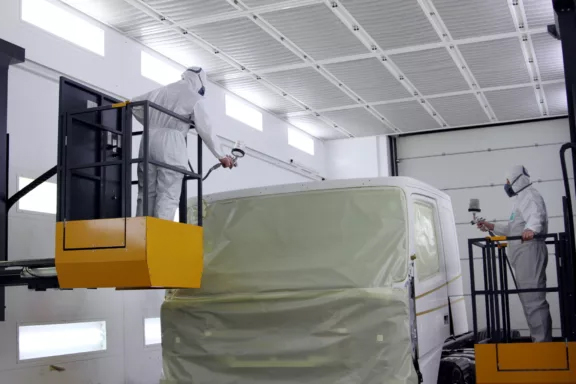
How Pneumatic Platforms Transform Heavy Vehicle Painting
The Manlift EX3 addresses the core challenges of large vehicle refinishing through intelligent design:
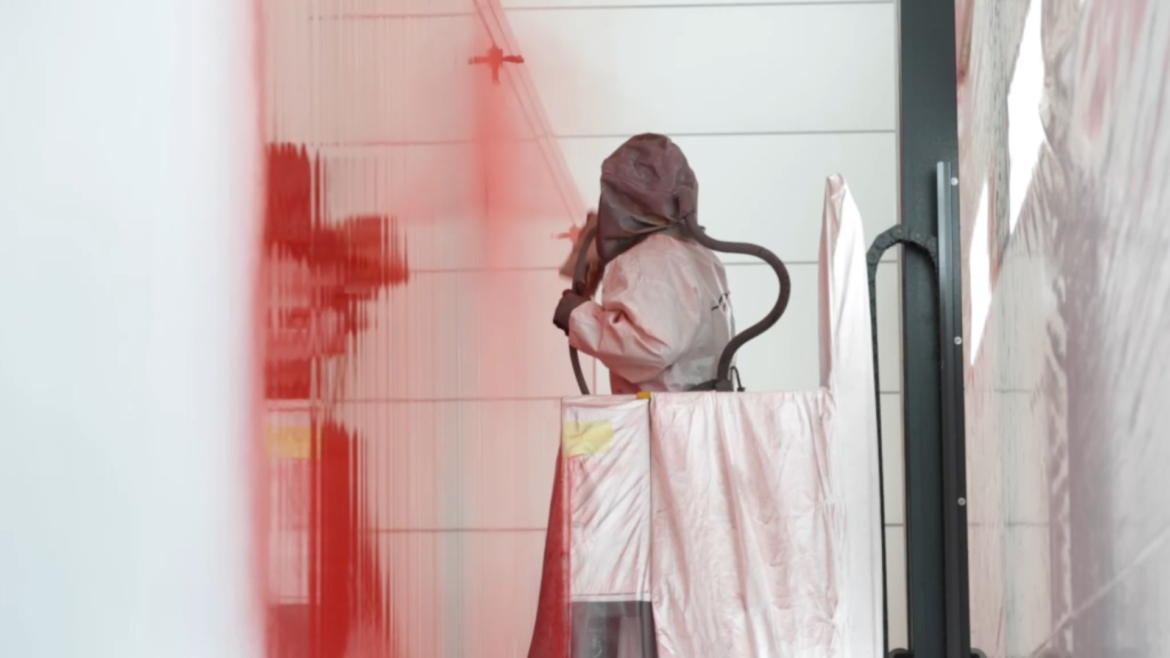
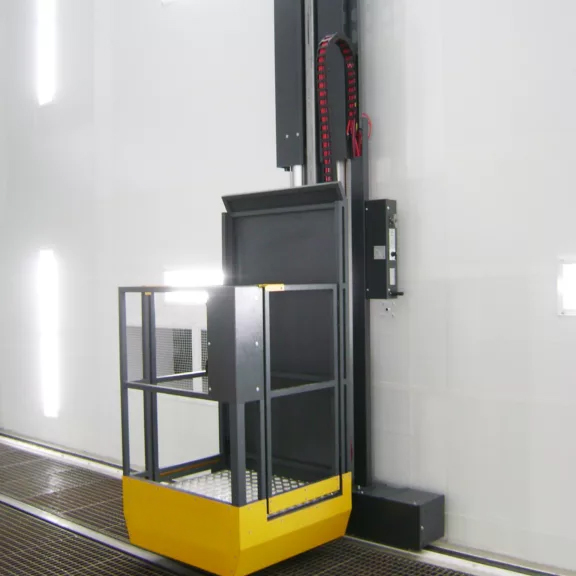
Complete three-dimensional access. Three intuitive pneumatic levers give operators total control. One lever handles vertical movement from 400mm to 3,300mm working height. Another extends the platform up to 1,200mm toward the workpiece. The third moves the entire unit horizontally along a wall-mounted rail system—covering the full length of your spray booth. This means painters can use the manlift to access any point on a truck, bus, or machinery without climbing down and repositioning.
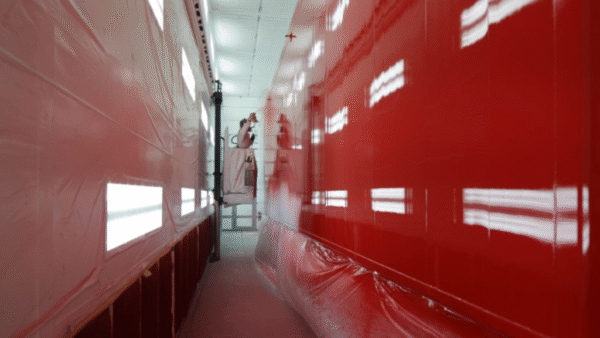
Wall-mounted design preserves floor space. The rail system mounts to the spray booth wall, keeping platforms suspended above ground level. Your floor stays clear for vehicle positioning and movement. In facilities operating multiple shifts or handling varied vehicle types, this flexibility proves invaluable.
Built for hazardous spray environments. The Manlift EX3 Series runs entirely on pneumatic power with zero electrical components. This makes them fully ATEX Zone 2 Category 3G compliant for use in explosive atmospheres. In a spray booth environment saturated with flammable paint vapour, this isn’t a nice-to-have feature—it’s essential. The systems operate on standard 7-8 bar compressed air supply and run whisper-quiet at under 75 decibels.
Designed for operator safety. Enclosed cages feature 1,120mm safety railings with a 150mm plinth to prevent tools or materials falling. Self-closing doors on both sides include mechanical locks to prevent accidental opening during operation. The platform comfortably handles 150kg maximum load with stable, precise positioning that eliminates the precarious footing associated with ladder work.
Choosing the Right Platform Size
The Manlift EX3 range includes four models sized for different vehicle types and booth configurations:
- Manlift EX3-580 (920-1,420mm reach): Light commercial vehicles, vans
- Manlift EX3-730 (1,070-1,970mm reach): Standard trucks, smaller buses
- Manlift EX3-830 (1,170-2,270mm reach): Large trucks & buses
- Manlift EX3-830MAX (1,270-2,470mm reach): Oversized equipment, industrial machinery
All models share the same 900mm cage length and can cover vertical travel of 2,900mm, with horizontal movement speeds up to 25 metres per minute along the rail system. For operations coating multiple vehicle types, the appropriate model ensures operators
Real-World Applications Across New Zealand
The benefits of professional access platforms extend across the full spectrum of heavy vehicle refinishing operations:
Fleet painting and refinishing. Transport companies maintaining truck fleets benefit from faster turnaround and consistent finish quality. When you’re repainting multiple vehicles per week, labour time savings compound quickly. The ability to position two operators at different heights simultaneously can cut job times dramatically.
Bus depot operations. Buses present massive surface areas at awkward heights. Pneumatic platforms let painters work the entire length and height of these vehicles without constant equipment repositioning. The stable platform positioning ensures consistent spray coverage even on long bus panels.
Agricultural and construction machinery coating. Tractors, harvesters, excavators and other large equipment combine height with irregular shapes and overhead components. The three-axis movement of pneumatic platforms means operators can access unusual angles and overhead surfaces that would be nearly impossible to reach safely from a ladder.
Commercial and industrial equipment. Specialist coating operations handling everything from shipping containers to industrial plant equipment need flexible access solutions. The wall-mounted rail system adapts to different booth lengths, while the range of platform sizes accommodates varied workpiece dimensions.
The Business Case: Safety and Efficiency
Investing in professional access equipment isn’t just about compliance—it’s about operational performance. Consider the measurable impacts:
Reduced labour time. Intuitive controls allow painters to position themselves in seconds rather than minutes. Over the course of a full vehicle repaint, this translates to hours saved. For busy commercial operations, this capacity increase has genuine financial value.
Improved finish consistency. Stable platform positioning means consistent spray distance and angle. Painters can focus on technique rather than balance. The result is better first-time quality and fewer expensive reworks.
Enhanced workplace safety. Enclosed platforms with safety railings, self-closing doors, and stable footing dramatically reduce fall risk compared to ladders. Under the Health and Safety at Work Act 2015, employers have clear duties to eliminate or minimise risks where practicable. Purpose-built access equipment helps meet these obligations while protecting your team.
Long-term reliability. Pneumatic systems require minimal maintenance compared to complex hydraulic or electric alternatives. The welded steel tube construction withstands the heat, paint mist, and chemical exposure typical of spray booth environments. These platforms are built for decades of daily use.
Integration with Your Existing Spray Booth
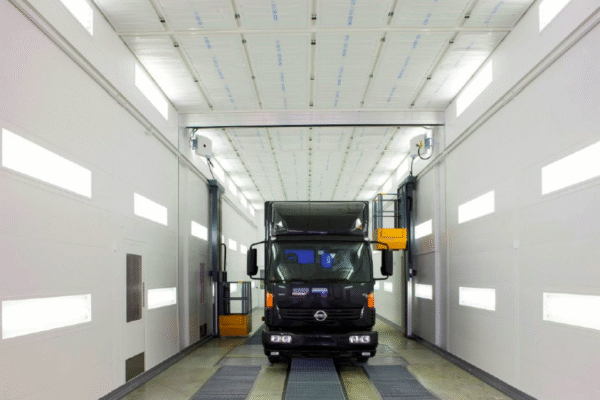
The Manlift EX3 Series is designed for straightforward integration with existing heavy vehicle spray booth infrastructure. The wall-mounted rail system installs along the booth length, with the platform running on compressed air already available in most facilities. For operations currently using booths sized for trucks and buses, adding pneumatic platforms is a logical evolution rather than a complete system overhaul.
The key consideration is matching platform specifications to your typical workpiece dimensions and booth configuration. Egmont Air works with operators to specify the appropriate model, rail length, and installation approach for each facility’s unique requirements.
Moving Beyond Ladders: The Future of Heavy Vehicle Refinishing
The heavy vehicle refinishing industry in New Zealand is maturing. Customer expectations for finish quality continue rising. Workplace safety standards are rightfully stringent. Competition for skilled spray painters remains high. In this environment, professional operations need every advantage.
Purpose-built access equipment is a fundamental shift from treating height access as something to manage toward treating it as a competitive advantage. When your painters can work faster, safer, and with better quality outcomes, everyone wins—your team, your business, and your customers.
If you’re currently repainting trucks, buses, or heavy machinery using ladders or temporary scaffolding, it might be time to consider whether your access method is helping or hindering your operation.
Download the Complete Technical Specifications
Want to dive deeper into the Manlift EX3 Series specifications? We’ve compiled all the technical details, dimensions, safety certifications, and operating specifications into a comprehensive product data sheet.
Download the Manlift EX3 Series Product Data Sheet to review:
- Detailed specifications for all four models (EX3-580 through EX3-830MAX)
- Reach dimensions, cage specifications, and load capacities
- Operating speeds and air supply requirements
- Safety features and ATEX Zone 2 compliance details
- Installation requirements and booth integration considerations
The data sheet provides everything you need to assess which model suits your specific spray booth configuration and vehicle types.
Ready to improve your spray booth access?
Egmont Air specialises in comprehensive dust and fume extraction solutions for professional spray operations across New Zealand. Our team can assess your heavy vehicle refinishing requirements and recommend the access platform configuration that best fits your facility and workload.
Contact Egmont Air to discuss pneumatic access platforms for your spray booth operation.